By: Chris Chew
Want to become not just merely a good guitarist, but a great
one, then you must master the guitar fret board. A guitar fret
board is the flat section on the front of the neck of the
guitar. You play guitar chords and select notes to play on the
fret board. There are metal bars embedded across the board
dividing it into several parts and these parts are called frets.
Yes, it may seem at first almost impossible, especially for the
novice guitarist to know every single note on every single fret,
however, if you want to be a great guitarist, it is critical to
learn them all. It may be more difficult than learning the notes
on the piano but with dogged determination, you can master all
the notes and chords on the guitar fret board.
Some people suggest that you can practice the guitar mentally.
Frederick Noad the author of "Solo Guitar Playing" suggest
mental practice methods such as "Learning by Equivalent Notes",
"Transfer of Position" and "Learning by Fret". You must keep
memorizing the notes and positions until you know when to play
the notes instinct even with eyes closed.
Position-to-note and note-to-position are also mental practice
methods. This means that whenever you think of or see a position
you must know exactly which notes are there. Similarly, whenever
you see or think of a note, you must know exactly where to play
it on the fret board.
You can also design yourself some memory games or download some
that are available on the internet. These games usually use
memory cards, which have on them either the fret numbers or the
position, or both. You must look at each card and give the
relevant information straight out from your memory.
For instance, if you pick up a card which says "Fret 3", you
will have to say "G C F A# D G" out loud. Mnemonics are used for
all sorts of learning include learning how to play the guitar.
It is a very useful tool in helping you to master the guitar
fret board.
Here is an example of Mnemonics - An Elephant was chasing an Ape
with a Dog but tripped over a Gator out popped a Bird eating an
Emu, helps you learn the open notes of fret 12 and 24. The
capitalized letters in bold are the open notes. If you are witty
enough, you could come up with your own mnemonics to make your
learning the guitar fret board much more fun.
It is also critical to know your 'sharps' and 'flats' very well.
C sharp and D flat is the same note, right? However, when you
are playing away on your guitar, do you remember that? You must
know how it is played, both ways, equally well. This will show
that nothing can confuse you or make you hesitate while playing
the guitar. This makes you an expert on the guitar fret board.
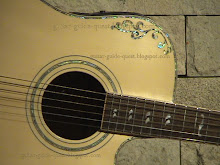
The guitar fret board has pearl markers strategically located
which are embedded in the wood. Usually, these markers are laid
in the exact same positions on every guitar. A standard guitar
will have these markings on the third fret, the fifth and the
ninth.
The twelfth fret has two markers because it is exactly one
octave higher than the open string. The fifteenth fret again has
a single marker. These markings are not only useful but
important as well because they can guide you to find and play
the right notes on the fret board more easily.
Mastering the guitar fret board is an extremely time consuming
and tiring work. However, the effort is well worth it because
once you mastered learning the guitar fret board because you
will become an awesome guitarist. This is because most
guitarists do not master the fret board and your guitar playing
skills will be far ahead of them.
Motivate yourself by learning one fret a time and set a
realistic time table when you will know every single note on the
fret board. Simply mastering the guitar fret board will make you
a much more proficient guitarist and who knows, you may one day
become a good superstar guitarist.
How To Become A Good Guitarist
Monday, June 9, 2008 1:29 AM
|0 commentsUkulele Chords: How to Work Out the Chords to Any Song
1:28 AM
|0 commentsBy: Al Wood
There are many places on the net where you can find the ukulele
to chords for songs. But eventually you'll want to play a songs
and not be able to find the chords for it. In those situations,
it's a huge advantage to be able learn songs by ear. This
article will give you a step by step guide to achieving this.
Step 1: Listen
This might be pointing out the obvious, but you have to listen
to the song before you try to work it out and before you even
pick up your ukulele. Try to pick out the structure of the song,
when the chords change, when sections are repeated. See if you
can relate the song to one you know already. Many songs are
structured in a very similar way. If you can relate it to a song
you know already, you're off to a head start.
Step 2: Listen to the Other Instruments
The ukulele isn't the easiest instrument to work out. If the
song you are trying to work out has a guitar or bass part,
listen to those. The first thing you want to work out is the
root note of each chord (for example the root note of Cm7 is C).
With the ukulele, it's not always clear which note is the bass
note. If there's a bass guitar on the song, try to follow that
on the ukulele.
Step 3: Fleshing Out The Chords
Once you have the root notes of the chords, you can build them
into full chords. The first thing to judge is whether the chord
is major or minor. The difference between major and minor chords
is fairly clear and you're probably already familiar with the
different sounds.
At this stage, knowing some chord theory is useful. Learning the
harmonized major scale will mean you can quickly assess whether
a chord is likely to be major, minor, seventh etc.
Step 4: Finishing Touches
Once you have the over all chord structure figured out and you
know whether the chords are major or minor, you can start to
work out any extra little notes in the chord. The most common
variation is a seventh chord.
The best way to pick up on these chord variations is to listen
to the melody. It's often easier to work out single notes than
it is full chords. If you can figure out how to play the melody,
all the better. Melody notes are often picked up on in the
chords. So if you can find these notes, they will help you find
those subtle chord variations.
Improving your ear is a great way for any musician to improve.
As well as helping your work out songs, it will improve your
improvisation and song-writing. Although it takes some time to
develop this skill, the rewards of doing so are very large.
What Can the Entrepreneur Learn from the Starving Artist?
1:27 AM
|0 commentsBy: Caleb Scoville
Are you as passionate about your business as a musician is his
or her music or a painter his or her paintings? If you're not,
you might as well stop reading now but if you truly care about
your business, you must treat it as art.
In school, I once heard this quote:
"Art is everything except things inherently necessary to
survival and procreation."
In this sense, a caveman running from a tiger is not art.
Climbing into the tree to escape the tiger is not art either,
but the moment he realizes he has outsmarted his hunter and
mocks the tiger with a taunting face or gesture from his perch -
that is art.
In this very same sense, your business is art. Sure, it brings
in money and affords you the ability to eat, have shelter and
otherwise provide for yourself - but going into a business for
yourself wasn't purely an act of survival.
Think about it. Could you physically continue living is you had
stayed in your job?
Going into business was an act of art because it went beyond the
basic needs and genetic programming of survival and procreation.
You went above and beyond the bare essentials to create the life
that you wanted and to fill a need in the world, much like a
painter or sculptor creates based on creative desire.
For this reason, it only makes sense to be as dedicated to the
needs of your business as the artist is his or her work.
As a budding musician in high school, I remember saving up and
spending my last dollar (literally) on a new Gibson Les Paul
guitar. It felt good because I knew that tool would help me in
my artistic endeavors for years to come. There are plenty of
painters who eat top ramen just so they can afford art supplies.
Here's the big difference between you and the starving artist
you have the ability to make your investments pay off, big time!
Most musicians and artists will never see a dime from their time
and money spent on their art and they are perfectly happy just
creating it. You have the advantage in this situation because as
long as you invest wisely, it can pay off over and over down the
line.
So - by now you're probably thinking, what does this all have to
do with audio and video anyway?
I've met so many business owners who are afraid to invest in new
marketing strategies or to create new information products
because of the initial cost. What they fail to see is that in
order to make great paintings, you must buy new paint every once
and a while.
Here are a few things you can invest a little bit of time and
money in that are sure to result in more profits and more free
time in the long run.
1. Teleseminars: Stop working exclusively one-on-one and
interact with your prospects and customers. You can record them
too and have them transcribed for easy product creation and
content repurposing. 2. Audio Information Products: These are so
easy to create, it's not even funny. In a matter of hours, you
can put a new information product together. 3. Podcasts and
Blogs: These are easy to create and manage and can help you gain
web traffic, credibility and new audiences. Podcasts are
especially useful because they help your prospects and customers
get to know you more intimately. 4. Viral Video Marketing:
Repurpose video and audio that you already have or create
marketing videos and distribute them to the top video sites.
People are literally becoming famous these days without even
having to leave their homes.
Did any of these suggestions overwhelm you? Or perhaps you
barely even know what they are. Remember, you only have so much
time and you can't be expected to do it all yourself.
That's why so many entrepreneurs have turned to us to outsource
their audio and video marketing and product creation needs.
We've done the research and we already have the best tools so we
can guide you through the process of implementing these new
marketing and product creation strategies. It's easier and less
expensive than you think.
Easy Guitar Tabs
1:15 AM
|0 commentsBy: sas_ricky
Guitar tabs are an easy solution for you if you have no idea of
how to read sheet music but are constantly bugged by the notion
that you want to be a guitarist. Guitar tabs are easy to learn
and allow you to begin playing songs right away, even if you are
not familiar with them. Once you have bought your first guitar,
it is time to begin looking for easy guitar tab versions of some
songs to find out what it feels like to be a guitar player.
Which songs you need tabs for depends on how you see yourself as
a musician. Do you want to play your favorite songs chiefly for
your own amusement or do you want to aim your repertoire at a
potential audience? Let us look at your audience for a minute.
The most popular songs in the world are all from years gone by.
If you sit a bunch of people aged between ten and fifty down and
play songs at them you will find some universal favorites, and
they will all be old songs. If you want to please a random
audience, your ultimate goal should be to have about one hundred
popular songs ranging from the 1940's to the present, but you
could probably narrow the range to just include songs going back
to the sixties.
So what are the easiest songs to learn from tabs? What can a
beginner guitarist learn quickly without too much trouble? Well,
I did a little searching on the internet concerning that
question, and I found that "Horse With No Name" contains only
two chords, and dead simple ones at that! You could be playing
that song in a convincing fashion today! "Knockin' On Heaven's
Door" makes use of the chords G D C and Am - all easy chords.
Building on chords you have acquired learning these songs, you
can go onto "House Of The Rising Sun" which uses Am C D F E and
E7. Once you have learnt that, it's only natural to go onto
another beautiful song, "California Dreamin'" which has the same
chords. If you do not like the idea of beginning your guitar
playing with these songs, do an internet search in the country
music and blues genres. Actually a working knowledge of twelve
bar blues is very useful for a guitar player just starting out.
Now for a short list of songs that are both easy to play and
have proven to be popular with audiences of all ages. You can
find tab arrangements for these songs by typing the titles into
a search engine. "Angie" by The Rolling Stones "Blowin' In The
Wind" by Bob Dylan "Brown Eyed Girl" by Van Morrison "A Day In
The Life", "Here, There And Everywhere" and "Hey Jude" by The
Beatles "I Walk The Line" by Johnny Cash "Tears In Heaven" by
Eric Clapton "Gloria" by Van Morrison "Hotel California" by The
Eagles "Behind Blue Eyes" by The Who "Scarborough Fair" by any
number of performers, and "White Room" by Cream
Once you have some guitar songs under your belt, you could learn
more popular favorites that do not fit into the "Easy Guitar
Tabs" category. Wilson Pickett's "Dock Of The Bay" and "American
Pie" by Don Mclean come to mind. But do not let the tastes of
the masses be your only guide. If, for example, you decide you
would like to do a folk guitar arrangement of Black Sabbath's
"Iron Man" then you could use tabs for the original electric
guitar version as a basis for your new work. With a bunch of
easy guitar tabs at your disposal, the only limits to your
musical achievements are your imagination and your audience's
supply of tomatoes.
How To Find And Select Your First Guitar
1:14 AM
|0 commentsBy: Barbara Salerno
starter guitar involves more decisions still. If you're shy
about committing to a purchase of a brand new instrument, here
are a few ways you can obtain a guitar:
If you have a friend or a relative who plays, ask them if they
have an extra guitar to loan or sell to you. Maybe they will
even give you some instructions on guitar playing. If you have
any musician friends or relatives, ask if they have a spare
guitar that you could borrow or buy. Most guitar freaks like
myself have more than one guitar, and you can only play one at a
time! So ask around first.
If you can't borrow, but don't want to commit to buying just
yet, you can rent a guitar. Most music stores rent out
instruments to beginning students on a weekly or monthly basis.
This is an affordable option because it requires a weekly or
monthly rental fee. If you then find that learning the guitar is
not for you, then at least you won't be stuck with a guitar that
you bought and now no longer want! And if you don't like the
instrument you rented you can try another one instead.
When you go to rent a guitar, explain to the store clerk that
you're just starting out and ask about their rental policy. Make
sure you can change the instrument if the first one doesn't work
out for you.
Ask about a repair policy, just in case you accidentally damage
your rented guitar. Try out several of the guitars in the shop
-- window-shopping will not do, you need to have a comfortable
feel for the guitar. You should be looking for a guitar that
isn't too wide or too large to hold, that you can hold
comfortably in your lap with enough room for the strumming arm
to hang down and easily strike the strings. Your elbow of your
strumming arm should be able to hang down from the edge of the
guitar in a relaxed fashion. Comfort is key! You will be
spending hours and hours in guitar practice, so make sure you
feel comfortable holding and playing the guitar. If you fall in
love with a particular guitar, so much the better! Practice will
be fun and not a chore, which will make a huge difference in
your mastery of the instrument.
If you decide to buy a used guitar you need to make sure it's
playable and doesn't have flaws that will impede your guitar
playing. Small chips or nicks in the top, neck or body can be
overlooked, because that is normal wear and tear. Belt buckles
can scratch up the back side of the guitar body, but just
scratches or nicks won't affect the sound or playability of the
guitar.
What you need to look for are cracks, big dents, poor action,
buzzing, and warped guitar necks. Do not buy a guitar with
cracks in the body or top, or dents that go through the surface.
The top, whether flat or archtop, must be free of any cracks and
should be flat and not warped or curved.
Does the guitar buzz when played? Buzzing can come from a
problem in the tuning pegs, the nut, too low an action, a warp
in the neck, or an uneven bridge. Do not buy a used guitar that
buzzes unless the store can have it fixed. Sometimes buzzing
requires only slight adjustments to be fixed, but sometimes it
may indicate a major problem with the guitar that you don't need
to deal with. Buzzing in a new guitar can usually be remedied
with a few slight adjustments, but buzzing in a used guitar is
bad, unless the store can fix it before you buy it.
Buzzing can also occur when you don't press down your finger
properly on the fret to produce a note. Since you don't yet know
how to play, ask the store clerk to play the guitar for you to
make sure it doesn't buzz.
Try the guitar out. Do the strings stay in tune? If not, there
can be structural problems with the tuning machines and you
definitely do not want to deal with that. Play the guitar for
several minutes in the store, or ask someone else to play it so
that you can determine whether the strings stay in tune. It's
like buying a used car: you don't want to inherit someone else's
headache. Generally, a reputable guitar store will take care of
problems with used guitars before they place them for sale. But
pay attention if you are buying used guitar: check the guitar
out from headstock to bridge. If something seems amiss, look for
another guitar! If you buy on eBay or another online vendor,
make sure there is a return policy.
Next, check the action. When you press the strings down against
the fingerboard with the fingertips of your playing hand make
sure there isn't a lot of space between the strings and the
fingerboard. The space between the upper fingerboard and the
strings is called the "action,"and it makes a huge difference in
the ease and speed of playing. A small distance between the
strings and fingerboard (without buzzing) is very desirable for
the beginner guitarist and in fact for all guitarists.
A large distance makes for very difficult playing and can
discourage the beginner altogether. You'll need to develop hand
strength to play in any case, so don't make it harder than it
already is by getting a guitar with poor action!
You also want to check the guitar neck. A warped neck will be a
real problem; it ruins the action and makes the guitar hard to
play. Sight down the neck of the guitar from the headstock
looking toward the guitar body, as if you were looking down the
sight of a rifle. There should be a very slight curvature or dip
near the body, not a big one, and the fingerboard should appear
even from side to side.
If the guitar is otherwise comfortable, sounds good, fits into
your body easily, and looks halfway decent, then it may just be
the one for you. Follow your gut feeling on this: if the guitar
feels really right, and has no major flaws, and you feel drawn
to it, there's your answer. After all, the guitar is going to
become your daily companion that you spend a lot of time with,
so make sure you can make friends with it easily. If you're
buying a used guitar from a shop, ask if there is any return
period, just in case you find something wrong with it when you
begin to practice.
The used guitar should come with a case or at least a
lightweight gig bag. A cardboard box is not an ideal storage
place for any guitar, used or new. If the case in not included
then try to bargain for a new or used hardshell case, which is
the toughest, most durable type of case, complete with felt
inner lining and a durable exterior. A regular guitar case is
cheaper than a hardshell, and will do fine if you are not in
transit a lot with the guitar. Or you can probably get a new
"gig bag," which is made of a lightweight plastic material, for
about $20-30.
When you buy a new guitar, follow the above guitar tips just the
same. Just because it is fresh from the factory doesn't mean it
is perfect! Check the action, the neck, and the body for flaws.
If the guitar buzzes, it may need some setup work so ask the
vendor about that. Buzzing is not necessarily a sign of a major
problem and can be corrected with some adjustments, but you
shouldn't have to make them yourself. Finally, when buying a new
guitar definitely inquire about a return period, and a warranty
for parts and labor in case something goes wrong. Find out if
you can bring the guitar back to the store where you bought it,
or whether you would have to ship it back to the manufacturer
directly. And until you are sure you want to keep the guitar,
save the box it was delivered in! Having to return a brand new
guitar is difficult enough without having to buy a guitar box to
return it in.
Once you get your guitar, practice, practice, and play it as
much as you can! Playing the guitar is a fabulous hobby that
will reward you with years of enjoyment in exchange for practice
and dedication.
So What's The Best Way To Learn Guitar?
1:13 AM
|1 commentsBy: Nick Seigal
While the guitar has been a popular instrument for many years,
more and more people are wanting to learn to play it for
themselves. Teens may fantasize about becoming the next big
rockstar, but there are many people who just want to learn to
play the guitar just so they can enjoy making music. So many of
these enthusiastic guitar fans don't find the best way to learn
guitar however, and after a few fruitless attempts they give up.
Everyone learns a bit differently. Besides that fact, we all
have different resources, different schedules, jobs and demands
on our time. If you are not making the strides you wish you
were, perhaps it is because you haven't found the best way to
learn guitar. There are many methods to learn to play this
instrument out there. A few are listed below. Theory Books There
are lots of theory books that you can buy to teach you how to
play the guitar. Some are actually very good, and if you learn
best this way, an excellent theory book may be the way to go.
This method is cheap, and you can learn at your own rate.
However, most of us don't do well using this method by itself.
If you are patient and determined however, this may be the best
way to learn guitar for you. Video Lessons You can find video
guitar lessons on tapes and DVDs in most music stores as well as
online. You may even find some video lessons online, some of
which are even free of charge. Learning with a video is dynamic
and you may stay more focused. Like the theory books, these
lessons allow you to practice whenever it is convenient for you.
The only real drawback is that you can't get feedback or
personalized attention like you would with a teacher. Private
Lessons If you have time and money to dedicate to your pursuit,
most people are successful if they take private lessons. A good
guitar teacher can design a program that is customized to your
learning style and you get feedback and one-on-one attention to
keep you on track. They can also correct any mistakes you may be
making early, so they don't become habits. This is the best way
to learn guitar for many people. Learning by Ear Some people who
were born blessed with natural musical ability find learning the
guitar by ear to be fun and effective. With modern technology
that allows us to slow down audio, this is a lot easier than it
used to be in generations past. Remember that you should be
having fun playing the guitar. If it is more stressful or
difficult than you think it should be, it could be the learning
strategy you've chosen that is making it this way. If you really
want to find the best way to learn guitar, you may need to try
many methods before you find the one that you like best. If you
have the money and the time to practice regularly, you'll find
that having private lessons will be the quickest way to achieve
the goal you've set.
Acoustic Guitar Tuning Help
1:12 AM
|0 commentsBy: Eryn Langers
If you play an acoustic guitar, you should tune it every time
you play whether you're playing for a show or simply practicing.
Besides, how would you like playing a guitar that's out of tune?
If you're a novice guitar player, you need to know the
importance of acoustic guitar tuning earlier on. Many novice
guitar players end up frustrated with themselves when they play
because they neglected to learn how to tune an acoustic guitar
and the importance of doing so every time they use their guitar.
Learning how to tune an acoustic guitar by ear takes time and
lots of practice. If you're a beginner, you can learn acoustic
guitar tuning by using an electronic tuner. An electronic tuner
costs only $20 so it's a pretty good investment. Make sure that
you buy an electronic tuner designed specifically for guitars
because such a tuner can tell what string you're playing.
When you're ready to begin acoustic guitar tuning, place the
electronic tuner on a table or stool next to you. Switch the
tuner on and then pluck the first string on your guitar. The
electronic tuner has a microphone that will help it sense which
string you're tuning. There is an indicator on the electronic
tuner that will let you know if you are close to the right pitch
for that string. The indicator will also let you know if you are
tuning sharp or flat. With your electronic tuner's help, you can
keep adjusting the string on your guitar until the indicator
tells you that the string is in tune.
You can learn acoustic guitar tuning without using an electronic
tuner. However, you'll still need something to help you tune the
strings at the right pitch. You can use another acoustic guitar
or a piano. You can also use a tuning fork or even an MP3.
To tune your acoustic guitar, begin by tuning the low E (the 6th
string) to the reference pitch. When you've got the 6th string
tuned, tune the other five strings to that note by following
these steps:
1. Play the 6th string (the one that's already in tune) on the
5th fret. Tune the open 5th string to that note.
2. Play the 5th string on the 5th fret. Tune the open 4th string
to that note.
3. Play the 4th string on the 5th fret. Tune the open 3rd string
to that note.
4. Play the 3rd string on the 4th fret. Tune the open 2nd string
to that note.
5. Play the 2nd string on the 5th fret. Tune the open 1st string
to that note.
That's it -- you've got your acoustic guitar tuned!
If you want to be able to accurately tune your acoustic guitar,
you'll need to use an electronic tuner. However, you can try
tuning your guitar the old fashioned way first and then check
your work against an acoustic guitar to see how close you got to
the right pitch for each string. If you tune your acoustic
guitar this way, you'll be able to develop the ear for acoustic
guitar tuning.